After this project.
After this quarter.
After things settle down.
It is one of the most common agreements leaders make with themselves.
A quiet promise that rest, recovery, and renewal are coming — just not yet. Not while there is still this much to do.
It feels reasonable.
It even feels responsible.
It sounds like a leader who understands that some things have to wait.
But “later” has a way of never quite arriving.
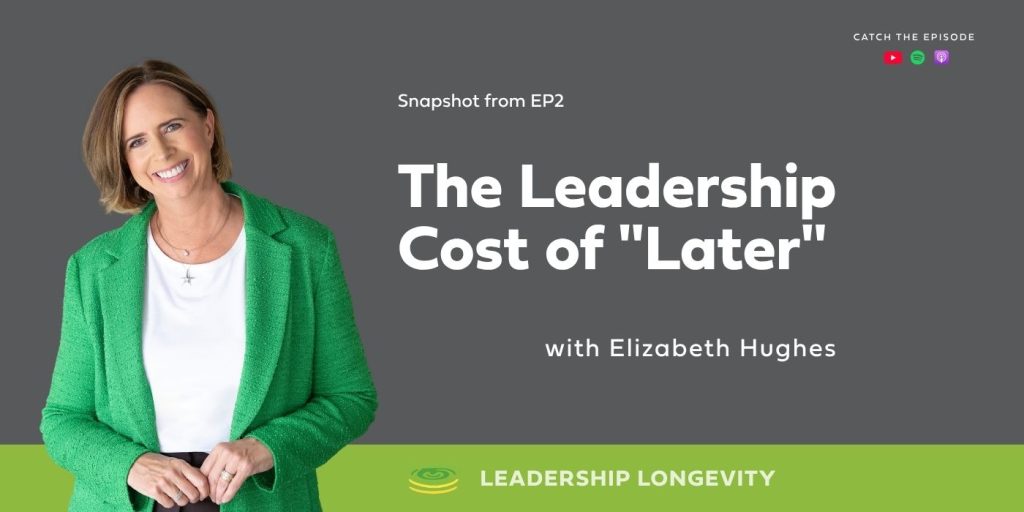
Episode 2 of the Leadership Longevity Podcast dismantles the second myth embedded in modern leadership — the Myth of Deferral. The belief that health, restoration, and self-investment can be postponed until the conditions are right. That the leader who waits will somehow arrive at that quieter season intact.
Biology tells a different story.
Elizabeth explores why deferral isn’t discipline — it’s a slow form of self-abandonment that erodes the very capacity leadership depends on. She introduces the concept of future self continuity, unpacks the five domains of resilience, and shows why the smallest consistent actions don’t just accumulate. They compound.
This episode isn’t a conversation about self-care as a reward for hard work. It’s a conversation about infrastructure. About the quiet, daily deposits that determine whether your leadership strengthens or diminishes over time.
The design begins here. Not later. Now.
What you'll discover in this episode
- The myth of deferral and how it quietly drains your leadership capacity
- How future self continuity changes the way you invest in health today
- The five domains of resilience — and how micro-actions in each create compounding returns
- Closing the gap between “I will” and “I did”
- Why honouring your own timeline liberates your leadership and strengthens your legacy
The myth of later
There is a particular kind of myth that doesn’t look like a myth at all.
It looks like patience. Like strategic prioritisation. Like a leader who understands what matters most right now.
The Myth of Deferral — the belief that health, recovery, and genuine renewal can be postponed until the work calms down — is one of the most seductive stories in modern leadership. Because it always sounds reasonable.
The project is real. The deadline is real. The pressure is real.
But “later” is a moving target. And the work never fully calms down, because the nature of leadership is that there is always more of it.
What makes this myth so costly is not that it fails loudly. It fails quietly — in the slow erosion of the capacities leadership depends on most.
“Later is a moving target, and leaders who wait for later rarely arrive.” — Elizabeth Hughes
The cost no one accounts for
There is a particular kind of leader Elizabeth has come to know well.
The steady one. The reliable one. The emotional anchor — for the team, for the organisation, for everyone around them.
They are carrying the invisible load. The worries, the tensions, the unspoken pressures. And because they are so focused on supporting everyone else, their own needs get quietly pushed to the edges.
I’ll rest later. I’ll breathe later. I’ll take care of myself later.
It feels generous. It even wins praise. But praise is not the same as sustainability. And generosity without boundaries becomes depletion.
Every time a leader overrides the signal to pause, to restore, to invest in their own resilience — they are making a withdrawal from an account they cannot see clearly. Until the balance runs too low to ignore.
Clarity dims. Presence contracts. The decisions that once felt sharp begin to feel heavy.
Deferral doesn’t feel like self-abandonment in the moment. It feels like dedication.
But the cumulative effect is the same.
“Deferral is the quietest form of self-abandonment.” — Elizabeth Hughes
Why the future self changes everything
Here is where the science becomes both grounding and quietly confronting.
There is a concept called future self continuity — how connected we feel to the older version of ourselves. The leader we will be in ten, twenty, forty years time.
When that future self feels distant, abstract, almost like a stranger, the brain does something predictable. It prioritises the urgent over the important. It invests in today at the expense of tomorrow. It defers health because the consequences feel so far away.
But the future self is not a stranger. They are you — with more years, more wisdom, and, as Elizabeth puts it, considerably fewer buffers.
When leaders begin making decisions today on behalf of the leader they are becoming, the calculus shifts entirely. Health stops being a reward to be earned. It becomes infrastructure to be built.
The five domains — and why small actions compound
Resilience is not a single thing. It is built — and eroded — across five domains simultaneously: physical, mental, emotional, relational, and financial.
Each one influences the others. And each one responds to the same principle.
Tiny, consistent actions compound. Not dramatically. Not immediately. But with a reliability that effort alone can never replicate.
A single walk doesn’t change a career. But a decade of walks reshapes cognition, steadiness, and long-arc capacity in ways that no recovery weekend can manufacture. A single night of good sleep won’t transform leadership presence. But years of protecting sleep can.
This is precisely why deferral is so costly. When those small actions are postponed, it isn’t only the action that is lost. It is the compounding effect that would have shaped future capacity — the deposits that were never made.
“Tiny actions repeated consistently create exponential change.” — Elizabeth Hughes
Closing the gap between intention and action
Most leaders do not lack awareness that their health matters. What they lack is a bridge between knowing and doing — between the intention formed at the end of an exhausting week and the action that actually takes place.
Closing that gap is not a willpower problem. It is a design problem.
The question is not whether a leader values their future self. It is whether the daily architecture of their leadership reflects that value. Whether the small deposits are being made — or whether they are being deferred, again, until later.
Deferral lives in the gap between I will and I did.
A tiny experiment closes it.
Elizabeth introduces three tools to begin working with today: a micro-action drawn from any one of the five domains — a ten-minute walk, a page of something that stretches the mind, a 60-second grounding pause, a call to someone who matters. A reflective question to create a moment of honest awareness. And one small weekly practice, embedded and repeatable, that begins building the architecture now.
Not perfectly. Not dramatically. Consistently.
“Every choice you make today is a deposit or a withdrawal in your future self.” — Elizabeth Hughes
Honouring your own timeline
Leadership longevity is not accidental. It is the accumulated result of decisions made long before the cost of not making them becomes visible.
The leaders whose clarity, presence, and influence endure across decades are not the ones who found more time. They are the ones who stopped waiting for it. Who chose one small action, then another, and let the compounding do what effort alone never could.
Releasing the Myth of Deferral feels like stepping back into your own timeline. Not someone else’s — your own. Like time widening. Priorities realigning. Your future self becoming someone you actively honour, rather than someone you continually delay.
Steady. Intentional. Quietly liberating.
The design begins today. Not after the project. Not after the quarter.
Today — with the smallest experiment, the simplest deposit, the first choice that honours the leader your future self will need you to have been.
Listen to the podcast Subscribe to the Leadership Longevity Podcast on Apple Podcasts, Spotify, or YouTube.
Work with Elizabeth Ready to design leadership that renews rather than depletes? Book a discovery call at tmegrp.com