
Snapshot From Season 1: Health Isn’t Personal. It’s Structural
Your depletion isn’t your secret. Your team feels it even before you do.
In this snapshot, Elizabeth unpacks the neuroscience behind why health can never truly be personal, how a depleted prefrontal cortex hijacks your decision making, and why co-regulation means your steadiness, or your strain, spreads through your entire team whether you intend it to or not.
Health isn’t a perk you get to when things calm down. It’s the foundation your whole organisation stands on.
Snapshot From Season 1: The Cost of Stepping In Too Often
When you step in too often, your team doesn’t feel supported. They unconsciously step back.
So ask yourself, “Is this a moment that needs my intervention, or their growth?”
In this snapshot, Elizabeth breaks down the biology and systems mechanics behind self-sacrifice as a leadership pattern, why removing consequences quietly removes growth, and why financial pressure makes over-responsibility feel seductive rather than sustainable.
Self-sacrifice isn’t leadership. Sustainable generosity is, and this episode shows you exactly how to tell the difference.
Snapshot From Season 1: Recovery Isn’t a Luxury. It’s Leadership Infrastructure
Your body doesn’t recover in dramatic bursts. It recovers in seconds and minutes, not the holiday you keep telling yourself you’ll take eventually.
In this snapshot, Elizabeth breaks down the physiology of allostatic load, why elite performers extend capacity through rhythm rather than effort, and introduces the three tools that turn recovery into a repeatable leadership system.
Because endurance without recovery isn’t resilience. It’s depletion with better branding.
Snapshot From Season 1: The Leadership Cost of “Later”
What if the person you keep putting off … is you?
Your future self isn’t a stranger. They’re you, just with more years, more wisdom, and far fewer buffers.
In this snapshot, Elizabeth breaks down the science of future self continuity and why your brain quietly sacrifices tomorrow for today when that future version of you feels distant or abstract. She introduces the Longevity Blueprint Decathlon, a five-domain system for compounding small, consistent deposits into the leader, and human, you’re training to become.
Because deferral doesn’t announce itself. It hides in the gap between “I will” and “I did” — and closing that gap starts with one tiny, deliberate action, today.
Snapshot From Season 1: Stop Surviving Leadership. Start Regenerating It
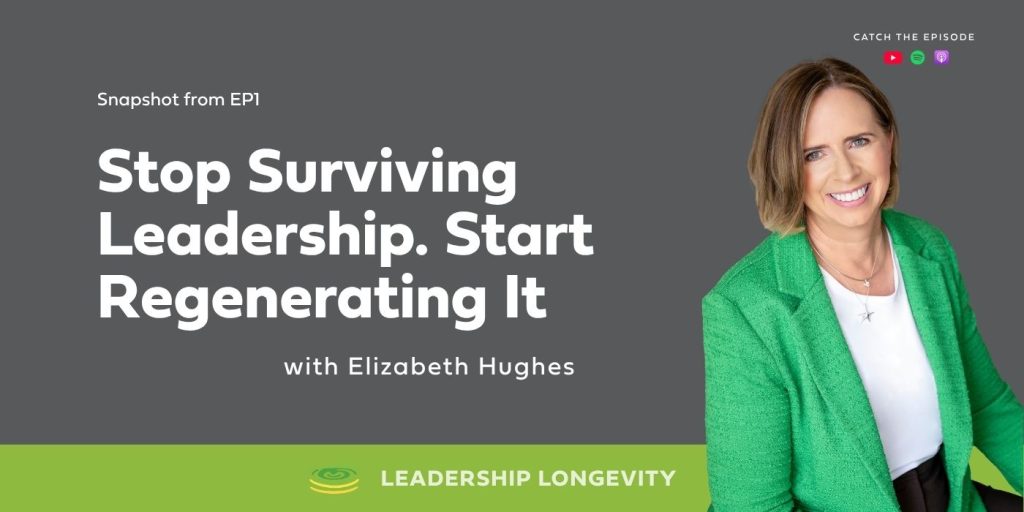
In this snapshot, Elizabeth names the four survivor drivers she sees in nearly every leader she’s worked with, including herself: predictable patterns that trade biology for performance, distort influence, avoid transition, and defer legacy indefinitely.
These aren’t character flaws. They’re what leaders are taught instead of regeneration — and naming them is the first step to changing them.
Myth 12: The Myth of Luck
There is a life waiting on the other side of the role you’ve built.
Mornings that belong to you. Relationships that have had time to deepen. An identity that knows who it is without a title to lean on.
Freedom that feels like expansion rather than like falling into something unplanned and unfamiliar.
Most leaders assume it will simply be there when they arrive. That the people will still be close. That the meaning will still be present. That the life will have held its shape while the career consumed the years.
It won’t.
Not by default. Not without design.
Myth 11: The Myth of Deferred Legacy
Most leaders have a version of legacy they’re saving for the end.
The reflection they’ll write when the pace finally slows. The wisdom they’ll pass on when there’s finally time. The meaning they’ll make of everything once the work itself is done.
It is a reasonable plan. But it misses something fundamental about how legacy actually works.
Legacy isn’t a future milestone.
It’s a present‑tense transmission.
And it’s already underway.
Myth 10: The Myth of Replacement
The new leader walks in. The room shifts toward them. And something stirs. Not jealousy, not resentment, but something quieter and harder to name.
If they take this on, what happens to me?
It is a question most leaders never say out loud. It surfaces in the gap between the handover conversation and the drive home. In the moment the successor gets the credit for something built over years. In the strange grief of watching someone else inhabit a space that once belonged entirely to you.
Most succession conversations never go here. Elizabeth does.
Myth 9: The Myth of the Endpoint
There is a question that surfaces in every leadership transition — whether the transition is intentional or arrives unexpectedly.
It doesn’t usually get said out loud. Not in the boardroom, not in the succession conversation, not in the carefully worded organisational update about the next chapter. And when a job ends suddenly, it doesn’t announce itself then either.
But it’s there.
Underneath the composure.
Underneath the professional narrative.
Underneath the gracious handover or the abrupt ending.
If I’m not the one holding this anymore, will I still matter?
It is one of the most human questions a leader can ask. And it deserves a more honest answer than most leadership conversations are willing to give.
Myth 8: The Myth of Disruption
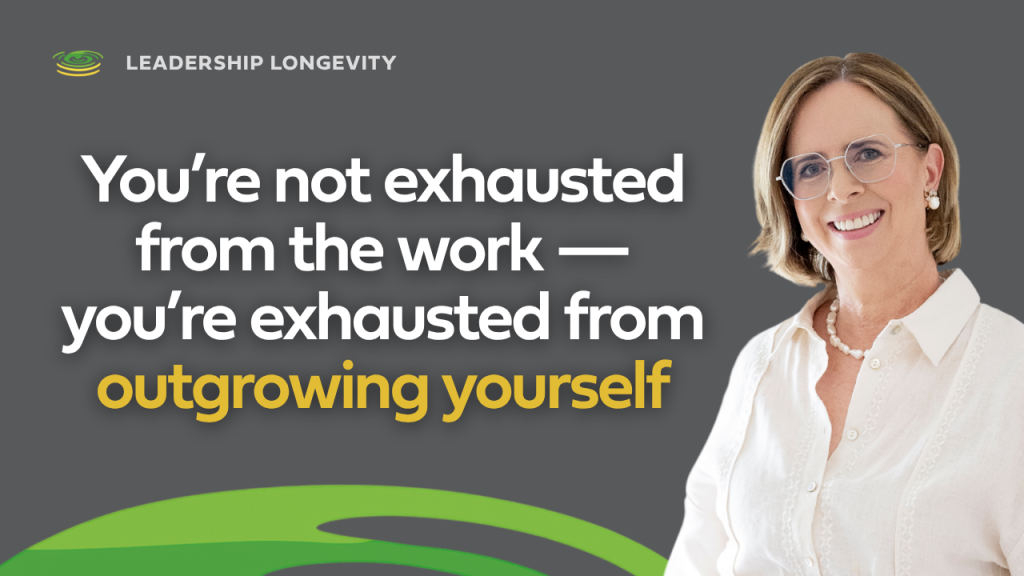
Most leaders in the middle of a major transition carry a quiet, private verdict about themselves:
I should be handling this better than I am.
It sits underneath the meetings, underneath the performance, underneath the carefully maintained composure. The sense that the disorientation they’re feeling is a personal failing — evidence of inadequacy rather than evidence of change.
That verdict, Elizabeth argues, is wrong.
And the cost of carrying it is far higher than most leaders realise.