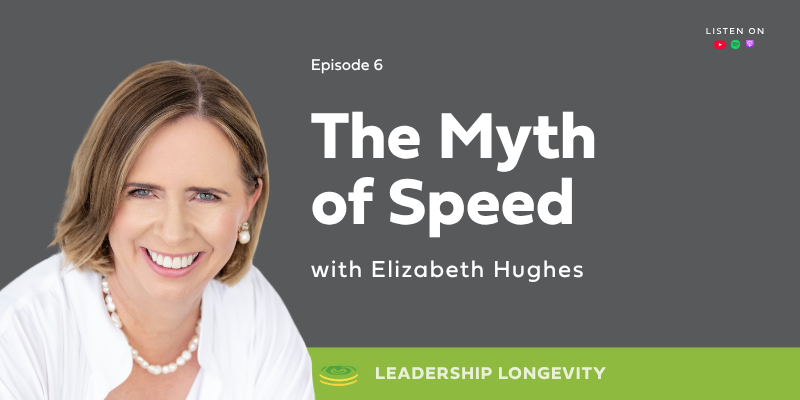
The Grip That Holds You Back
At some point in every leadership career, experience stops being the asset and starts being the obstacle.
Not because the experience wasn’t real. Not because the results weren’t earned. But because the world shifted and the strategies, styles, and identities that built the track record quietly stopped fitting the terrain ahead.
Most leaders sense this before they name it. And the response, almost universally, is to hold on tighter.
What you'll discover in this episode
- Why the very thing that once made you effective can quietly become the thing that holds you back
- The myth of holding on and how it distorts your influence
- The messy middle where adaptation actually happens
- The neuroscience behind why leaders grip what once worked
- How holding on fractures your external layer and travels through your team
- Tools to loosen your grip and start leading adaptively
Clinging as protection
Holding on is not a flaw. It is a deeply rational response to a deeply uncomfortable situation.
Clinging isn’t resistance — it’s protection, a fear wearing armour that makes perfect sense until it doesn’t.
What a leader grips when they resist change is rarely just a method or a style. It is proof — years of accumulated evidence that they are capable, credible, and worth following. Releasing that feels less like updating an approach and more like dismantling the case for their own authority.
Elizabeth observes that the most experienced, most committed, most self-aware leaders are often the ones gripping hardest. Not out of arrogance, but out of something far more human.
The fear of losing what once made them strong.
“Leaders don’t cling because they’re stubborn. They cling because they’re scared of losing what once made them strong.” — Elizabeth Hughes
And it’s not just leaders — whole systems cling to what once made them strong, even
as the world around them evolves.
When effectiveness becomes a cage
There is a particular trap that only the most successful leaders fall into. The better a strategy has worked, the more thoroughly it gets reinforced – in behaviour, in identity, in the unspoken story a leader tells themselves about what good leadership looks like.
Over time, that reinforcement calcifies. What began as a strength becomes a default. What was once an adaptive choice becomes an automatic response. And the leader who was once sharp and responsive finds themselves reacting to a new landscape with tools built for an old one.
Elizabeth points out that this is not a failure of intelligence or commitment. It is the natural consequence of success and the reason why the leaders who shaped the most enduring careers are the ones who learned to question what they’d mastered.
“What once made you effective can quietly become what holds you back — especially in the messy middle of change.” — Elizabeth Hughes
The place nobody talks about
The messy middle has no map. It is the space between who a leader has been and who the next chapter requires them to become — the Event of Adaptation in real time. Where the old identity no longer fits cleanly and the new one hasn’t yet solidified.
It is uncomfortable in a way that is hard to articulate.
The past offers the solid ground of known competence.
The future offers the uncertain ground of unrealised potential.
And the present asks a leader to stand in the gap between them, holding both at once, without the reassurance that they’re doing it right.
“In the middle of change, the past feels like an anchor, the future feels like a fog, and the present feels like a tightrope.” — Elizabeth Hughes
Most leadership work skips this part. But this is the part that matters most.
What the brain is actually doing
The resistance that shows up in the messy middle is not weakness. It is neurobiology.
The brain does not distinguish between a threat to physical safety and a threat to identity. When the strategies and self-concepts a leader has spent years building come under pressure, the nervous system responds accordingly.
By tightening. Defending. Preserving what it has worked hard to construct.
This is not resistance to be overcome through willpower. It is a protective mechanism to be understood and worked with.
The brain is doing exactly what it was designed to do — protect the internal system when identity feels under threat.
The patterns that travel downstream
What a leader grips internally does not remain internal. It expresses itself outward in the decisions made, in the conversations avoided, in the subtle signals that communicate where the edges of acceptable change actually are.
Teams read these signals with extraordinary precision. And over time, the leader’s patterns of holding on become the team’s inherited operating conditions, the invisible ceiling on how much adaptation the culture believes is actually possible.
“Influence is always inherited, and the patterns you grip today become the conditions the next layer of leadership inherits tomorrow.” — Elizabeth Hughes
The 10% shift
Adaptation does not begin with a wholesale transformation. It begins with a loosening, small enough to feel manageable, significant enough to create genuine movement.
Releasing the grip by just 10% is enough to let something new in. Not abandoning what was built, but holding it differently, with enough space to ask whether it still serves, rather than assuming that because it once did, it always will.
A 10% loosening is enough to change the internal conditions of the system:
enough space for rhythm to return, for capacity to rise, for adaptation to begin.
Adaptability isn’t instability — it’s intelligence. Flexibility isn’t weakness — it’s influence.
The leaders whose influence endures are not the ones who stayed constant. They are the ones who evolved with enough self-awareness to carry forward what mattered and enough courage to finally set down what didn’t.
And in a world gripping harder than ever, leaders who can loosen even slightly become the ones who shift the conditions around them.
That is not loss. That is how leadership grows.
Listen to the podcast Subscribe to the Leadership Longevity Podcast on Apple Podcasts, Spotify, or YouTube.
Work with Elizabeth Ready to design leadership that renews rather than depletes? Book a discovery call at tmegrp.com