Your Pace Is Your Culture
Speed doesn’t feel like a problem when you’re inside it. It feels like the job. It feels like how you show up, how you care, how you demonstrate that you’re across everything that needs you.
For many leaders, pace has become so fused with identity that questioning it feels almost like questioning their commitment.
But somewhere along the way — gradually, almost imperceptibly — the pace stopped being a choice. It became an inheritance. Something the environment handed over, something AI quietly accelerated, and something the leader simply absorbed without ever deciding to.
That is where the real problem begins.
What you'll discover in this episode
- Why leaders rush and what it’s doing to your influence
- The myth of speed and what it quietly teaches your team
- When speed is a strength and when it becomes the problem
- What speed looks like inside an organisation
- The neuroscience and ecology of why rushing costs you more than you think
- How AI accelerates urgency and compresses leadership clarity
- Why slowing down is how you reclaim your leadership
- Tools to reclaim your pace and lead from capacity
The myth hiding inside momentum
Speed has never been the problem. Elizabeth points out that the myth isn’t that speed exists. It’s the unexamined belief that speed equals effectiveness. That moving faster is the same as leading better. That urgency, sustained long enough, becomes a form of excellence.
It doesn’t. It becomes a ceiling.
“The myth isn’t that speed exists. The myth is the belief that speed equals effectiveness.” — Elizabeth Hughes
There is a version of speed that is genuinely useful. It’s responsive, decisive, appropriately calibrated to what the moment actually requires.
And then there is the version that most leaders are living inside. It’s a chronic, ambient rush that stopped being a choice a long time ago and started being the only gear available.
AI intensifies this confusion. It compresses timelines, accelerates expectations, and creates an ambient pressure to match machine‑speed rhythms with human nervous systems. The difference between chosen speed and inherited speed becomes even harder to see — and even easier to mistake for competence.
What rushing does to the brain
The cost of chronic urgency isn’t just physical. The deeper consequence is cognitive — and it strikes at the very capacities leadership most depends on.
When a leader is in rush mode, the brain shifts into pattern matching. It defaults to what it already knows. Nuance narrows. Creativity retreats. The cognitive field collapses inward, processing only what is immediately familiar and discarding the peripheral information where the most important signals often live.
This is not a discipline issue. It is not a time management failure.
It is a nervous system response to an environment — and now an AI‑accelerated ecosystem — that moves at machine pace while the leader’s operating system was never designed to keep up with it.
When urgency becomes survival
For many leaders, the rush is a stress response wearing strategy’s clothes.
The body reads pressure as threat. Adrenaline floods the system. Movement accelerates — not because it’s effective, but because it feels safe. Rushing becomes the way a leader proves to themselves, and to everyone watching, that they have the situation under control.
“Rushing is often a stress response. Your body interprets pressure as threat. Your system floods with adrenaline and you move fast to feel safe. This isn’t strategy, this is survival.” — Elizabeth Hughes
And underneath that survival mechanism is something worth sitting with: Speed is often how leaders avoid confronting the uncertainty they’ve been moving too fast to feel. AI amplifies this avoidance by making everything feel urgent, immediate, and high‑stakes.
Slowing down becomes a confrontation with what the pace has been keeping at bay.
The pace that travels
What makes this more than a personal health concern is what speed does when it leaves the leader and enters the system.
The pace a leader keeps becomes the pace a culture inherits. Teams calibrate to the rhythm at the top. The urgency, the responsiveness, the unspoken signal that fast is valued and slow is suspect.
AI accelerates this transmission. Machine‑speed expectations at the top become machine‑speed norms everywhere else.
Over time, that rhythm stops being the leader’s pace and starts being the organisation’s operating assumption. Future leaders will inherit it without knowing where it came from. They will call it the culture. They will mistake it for normal.
Elizabeth stresses that this is the dimension of speed most leaders never see. Not what rushing costs them personally, but what it deposits into every layer of the system around them.
Reclaiming what urgency took
Slowing down is not falling behind. Elizabeth is precise on this point. It is the mechanism by which influence is reclaimed. Because clarity requires space, and wisdom requires pace, and neither can be produced on demand by a nervous system running on adrenaline.
The steadiest leaders in the room are rarely the fastest. They are the ones whose pace creates space rather than pressure. Whose rhythm gives the people around them permission to think clearly. Whose deliberateness signals that good decisions matter more than quick ones — especially in an AI‑accelerated environment.
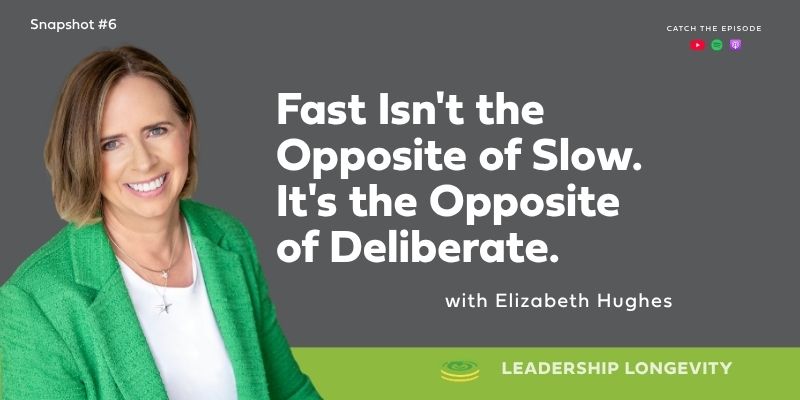
“Fast is not the opposite of slow. Fast is the opposite of deliberate. Leadership isn’t measured in velocity. It’s measured in the quality of your decisions and the stability of your influence.” — Elizabeth Hughes
Leading from capacity, not urgency
Reclaiming pace is not merely about slowing everything down. It is about choosing the speed rather than inheriting it from an ecosystem that has no investment in the leader’s longevity, clarity, or the quality of what they leave behind.
That choice begins with three practical tools to interrupt the pattern, understand what’s driving it, and build a rhythm that serves the leadership rather than erodes it.
Because the leaders whose influence endures are the ones who move with purpose, from capacity rather than urgency, from steadiness rather than speed.
That is the pace worth leading at. And it starts with deciding to reclaim it.
Listen to the podcast Subscribe to the Leadership Longevity Podcast on Apple Podcasts, Spotify, or YouTube.
Work with Elizabeth Ready to design leadership that renews rather than depletes? Book a discovery call at tmegrp.com