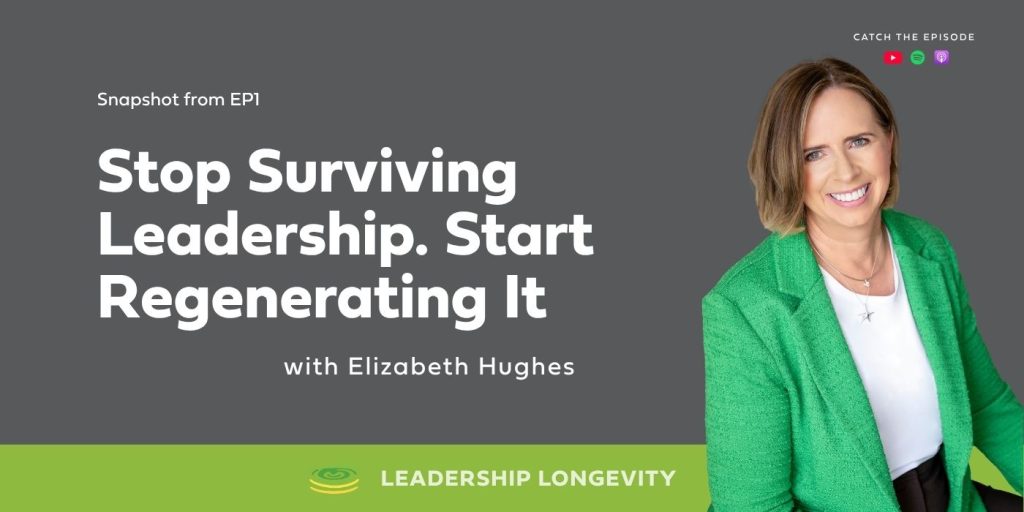
The Role Ends. The Influence Doesn't.
Why every transition — chosen or not — triggers the same fear.
There is a question that surfaces in every leadership transition — whether the transition is intentional or arrives unexpectedly.
It doesn’t usually get said out loud. Not in the boardroom, not in the succession conversation, not in the carefully worded organisational update about the next chapter. And when a job ends suddenly, it doesn’t announce itself then either.
But it’s there.
Underneath the composure.
Underneath the professional narrative.
Underneath the gracious handover or the abrupt ending.
If I’m not the one holding this anymore, will I still matter?
It is one of the most human questions a leader can ask. And it deserves a more honest answer than most leadership conversations are willing to give.
What you'll discover in this episode
- The myth of the endpoint and the identity fear underneath it
- How the fear of losing influence shows up across every kind of transition – chosen or not.
- What unexpectedly becomes possible when you’re no longer holding everything
- Why transitions expand influence rather than end it
- What leading from identity rather than position actually looks like
- How to see your influence beyond the boundaries of your current role – even when the role ends before you’re ready
The belief that quietly shapes every transition
Most leaders, if pressed, could articulate that influence outlasts a role. They’ve seen it in others. They believe it in principle.
And yet when the transition arrives — stepping out, stepping up, stepping across, stepping back — the same fear surfaces regardless of the circumstances.
Because the myth of the endpoint isn’t really about the mechanics of transition. It’s about something deeper.
The quiet, largely unexamined belief that influence lives inside the role.
That contribution requires the title.
That mattering is positional.
Elizabeth challenges this directly, not with reassurance, but with precision.
“Roles end, influence doesn’t. The myth of the endpoint tells you ‘If I step away, I’ll lose my influence. If I’m not in the role, I’m not valuable. If I’m not leading this, I’m disappearing.’ But influence is not positional. Influence is relational.”
— Elizabeth Hughes
Why leaders hold on past the point of serving
The clinging that happens at the edges of transition rarely looks like stubbornness. It looks like conscientiousness. Like ensuring continuity, like caring enough to stay engaged beyond the point where disengaging would feel clean.
Elizabeth notes that beneath most of it is not control.
It is fear.
The fear of losing a voice that has taken years to build.
The fear of becoming peripheral in a world that once centred around your decisions.
The fear of discovering that the influence you believed was yours was, in fact, borrowed from the position.
“We cling, we over-function, we hold on long after the role has stopped holding us. Not because we’re controlling, but because we’re afraid of losing our voice.” — Elizabeth Hughes
The identity gap
Elizabeth draws on identity research to name what most leaders experience but rarely have language for.
When a role ends, or shifts significantly, a temporary gap opens between the self that was defined by that role and the self that hasn’t yet found its new shape.
That gap feels like loss.
It has the texture of loss.
But it is something else entirely.
“Transitions create a temporary identity gap where the old role no longer defines you, but the new one hasn’t been fully formed. It feels like loss, but it’s actually a growth window.” — Elizabeth Hughes
The leaders who move through transitions with the most steadiness are not the ones who feel it least. They are the ones who recognise the gap for what it is and resist the impulse to fill it prematurely with the familiar shape of the role they just left.
What becomes possible on the other side
Elizabeth points to something that surprises most leaders who have moved through a significant transition – chosen or not – with enough openness to notice it.
What waits on the other side is not diminishment. It is a different kind of freedom.
Freedom from being the bottleneck, from being the anchor, from being the one who always had to hold everything together. Not because no one else could, but because the structure had been built around one person doing it.
“Their influence didn’t end, it evolved. And in that evolution, they discovered something they hadn’t felt in years. Freedom. Freedom from being the bottleneck, freedom from being the anchor, freedom from being the one who had always had to hold everything.” — Elizabeth Hughes
Before the transition forces the question
The leaders who navigate change with the most grace are not the ones who had the smoothest transitions. They are the ones who had already begun separating their identity from their title long before the transition arrived.
Not because they saw it coming.
But because they had built their sense of contribution on something more durable than a role -on the people developed, the culture shaped, the thinking expanded in every leader they ever sat across from.
That is what endures.
That is what the role never owned.
Knowing it – really knowing it – even before the question becomes urgent, is what makes the difference between clinging and moving forward with steadiness.
Your role is temporary.
Your influence is not.
Listen to the podcast Subscribe to the Leadership Longevity Podcast on Apple Podcasts, Spotify, or YouTube.
Work with Elizabeth Ready to design leadership that renews rather than depletes? Book a discovery call at tmegrp.com